.png)
Politics of a Contested Past

There is a city on the Dnipro River, founded by traders and princes more than a thousand years ago, that two nations currently at war both claim as their point of origin. Kyiv, the capital of modern Ukraine, is also, in the historiography still taught in Russian schools, the cradle of the Russian state, the site where Prince Volodymyr baptized his people into Orthodox Christianity in 988 and thereby inaugurated a civilizational lineage that Moscow, centuries later and hundreds of miles to the northeast, would claim to inherit in full. This is the historical scaffolding beneath a war that has killed and displaced millions of people since February 2022, and it raises a question that outlives any single battle: what does it mean for a nation's foundational story to be the same story claimed, with equal conviction, by the power seeking to erase it.
Ukraine's relationship to Slavic identity is neither simple affiliation nor simple rejection, and the attempt to force it into either category is itself part of the conflict. The East Slavic peoples, Ukrainians, Russians, and Belarusians, descend from a linguistic and cultural matrix centered on medieval Kyivan Rus', a federation of principalities that dissolved under Mongol invasion in the thirteenth century and fragmented thereafter into distinct political trajectories. Ukraine spent subsequent centuries under Lithuanian, Polish, Austro-Hungarian, and Russian rule in various configurations, a history of partition that produced a language, a folk culture, and a religious tradition recognizably Slavic but shaped by centuries of contact with Central Europe in a way that Muscovite Russia, oriented toward the steppe and later the Baltic, was not. To describe Ukraine as simply a fraternal branch of a pan-Slavic tree, as Russian state rhetoric insists, is to erase this distinct trajectory. To describe Ukraine as wholly separate from that broader Slavic legacy, as some nationalist framings insist in reaction, is to erase something else: a linguistic kinship, an Orthodox liturgical tradition, and a folk culture that genuinely does share deep roots with its neighbors. The honest position is the uncomfortable one, that Ukrainian identity is Slavic and distinct simultaneously, and that the insistence on choosing between those descriptions is a political demand disguised as a historical question.
The instrumentalization of this legacy did not begin in 2014, nor even in the Soviet period, though both moments intensified it considerably. Imperial Russian policy throughout the nineteenth century treated Ukrainian, then commonly termed Little Russian, as a dialect banned its use in print through measures such as the 1876 Ems Ukaz, and promoted a narrative in which Ukrainian particularism was a foreign-instigated deviation from an essential Russian unity. The Soviet period complicated this picture without resolving it. Ukrainian statehood and language received formal recognition within the Soviet federal structure even as the state engineered the Holodomor, the famine of 1932 to 1933 that killed millions of Ukrainians and that Ukraine and a growing number of other states now formally recognize as genocide, and even as later decades saw renewed russification of education and public life. A people can be granted the formal trappings of nationhood, a flag, a academy, a seat at the founding of the United Nations, while the substance of that nationhood is hollowed out by policy designed to make its distinctiveness administratively real but culturally negligible. Ukraine's twentieth century is, among other things, a case study in how empires can concede form while withholding meaning.
Independence in 1991 did not settle the question so much as relocate it into a new arena, one of competing post-Soviet trajectories. The three decades since have been characterized by an oscillation between governments oriented toward Euro-Atlantic integration and governments oriented toward continued alignment with Moscow, an oscillation that culminated in the Euromaidan protests of 2013 and 2014, the flight of President Viktor Yanukovych, and Russia's response: the annexation of Crimea and the fomenting of separatist conflict in the Donbas. It is worth pausing on the fact that this sequence is frequently described, in both scholarly and popular accounts, using the vocabulary of civilizational choice, Ukraine choosing Europe over Russia, as though the population of a country of more than forty million people, spanning considerable regional, linguistic, and generational variation, could be reduced to a single directional vector. That reduction is analytically convenient and empirically false, and its persistence in commentary on the war says something about how thoroughly the conflict has been absorbed into a binary framework that leaves little room for the actual heterogeneity of Ukrainian public opinion, historical memory, and lived experience.
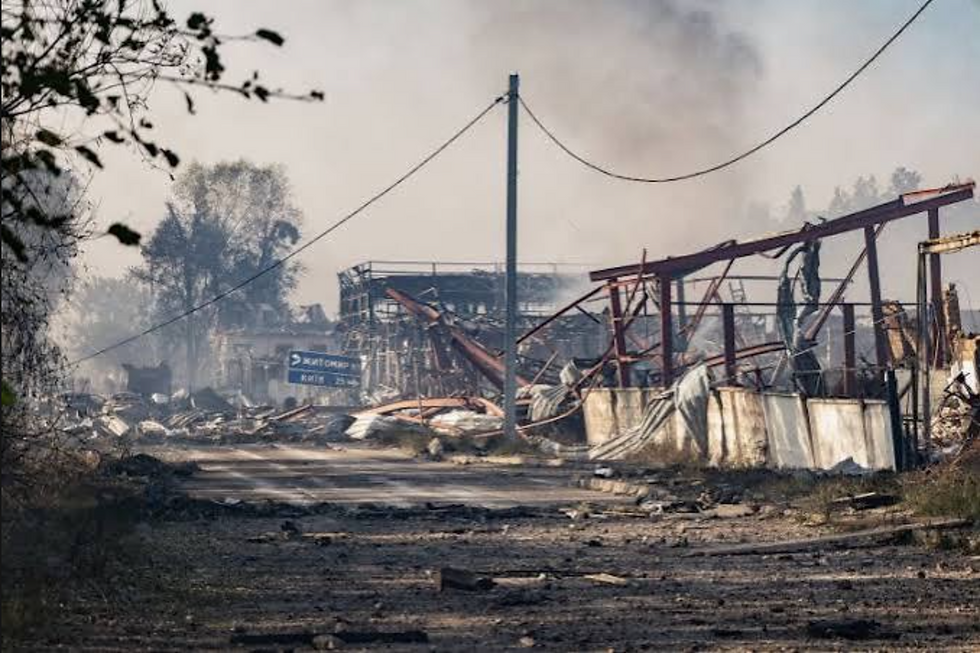
The full-scale invasion launched in February 2022 has, by mid-2026, settled into a grinding war of attrition along a roughly seven-hundred-and-fifty-mile front, punctuated by intermittent breakthroughs on both sides. Russia retains effective control of Luhansk province and continues to press against Ukrainian positions in Zaporizhzhia and around Pokrovsk in Donetsk, even as Ukraine has, at points, mounted local counterattacks and reclaimed limited ground. Both militaries have increasingly targeted infrastructure: Ukraine has struck Russian oil refineries and export terminals with long-range drones in an effort to constrain the revenue funding Moscow's war effort, while Russia has directed repeated missile and drone barrages at Ukraine's power grid, producing blackouts that in the depths of winter left residents of Kyiv without electricity for a considerable share of each day. Diplomatic efforts, including rounds of negotiation held in Istanbul, have produced prisoner exchanges and limited humanitarian arrangements without approaching a durable settlement of the war's core territorial and security questions. This is, in other words, a conflict that has stopped resembling a discrete event and has become instead a condition, an ongoing state that shapes economic policy, demographic trends, and generational experience on both sides of the front.
It is tempting, and analytically lazy, to treat the war as a simple morality tale in which Slavic fraternity is a cynical fiction wielded by an aggressor and nothing more. There is truth in the charge: the Kremlin's invocation of Slavic and Orthodox heritage functions, transparently, as a justificatory framework for a war of territorial conquest, and the claim that Ukrainians and Russians are one people has been deployed to deny Ukraine's right to independent political existence at all, most explicitly in President Vladimir Putin's own 2021 essay on what he termed the historical unity of Russians and Ukrainians. But the deeper and more uncomfortable truth is that the heritage being weaponized is not itself a fabrication, which is precisely what makes the weaponization effective. A wholly invented kinship could be dismissed outright. A real kinship, selectively narrated and stripped of the centuries of distinct development that followed it, is far more serviceable to imperial argument, because it borrows its persuasive force from something true even as it distorts the larger picture beyond recognition.
Scholars of nationalism, following Benedict Anderson's account of nations as imagined communities, have long observed that the raw material of ethnic and linguistic kinship rarely determines political outcomes on its own; it is narrated, selected, and organized by political actors toward ends those actors already hold. What the Russo-Ukrainian conflict demonstrates with unusual clarity is that the same body of historical material, the baptism at Kyiv, the medieval principalities, the Church Slavonic liturgical tradition, can be narrated toward diametrically opposed political conclusions: toward a claim of indivisible unity that erases Ukrainian sovereignty, or toward a claim of enduring distinctiveness that has, since 2022, hardened into a Ukrainian national identity considerably more unified and more assertively separate from Russian cultural gravity than existed before the invasion. Public opinion research conducted since 2022 has consistently found a marked decline in the share of Ukrainians identifying Russian as a first language of preference and a corresponding rise in identification with a distinctly Ukrainian cultural framework, a shift that is itself among the more significant and least remarked-upon consequences of the war: Russia's invasion, waged in part to arrest Ukraine's civilizational drift away from Moscow, appears to have accelerated precisely that drift, converting an ambivalent and regionally variable identity into a more settled and more oppositional one.
What, then, does responsible engagement with this history look like, for observers outside the immediate combatants? It requires holding two propositions simultaneously that popular discourse generally prefers to separate. The first is that Ukraine's claim to sovereign, self-determined nationhood is not diminished in the slightest by its genuine linguistic and cultural kinship with Russia and Belarus; ancestry has never, in any other context, been treated as grounds for the extinguishing of a neighboring state, and the argument's application here is opportunistic. The second is that the flattening of Ukrainian identity into pure opposition to Russia, useful as wartime consolidation and understandable as a response to invasion, risks producing its own distortions, a historiography that retroactively projects the current, hardened sense of separateness backward onto centuries in which the boundary was considerably more porous and the lived experience of ordinary people considerably less organized around the national categories that now seem self-evident. Neither the imperial narrative nor its nationalist mirror image serves the historical record particularly well; both are, in their own ways, casualties of the same war they claim to explain.
The city on the Dnipro predates both the empire that claims it and the nation that now defends it, and it will presumably outlast the current configuration of the conflict in some form neither side has yet fully imagined. What the war has made unmistakably clear is that history, in this region as in most others, is an active site of contest, continuously rewritten by whoever currently holds the pen, the territory, or the missile battery. The task for those trying to understand Ukraine honestly is to notice how much political weight is being placed on the past by actors in the present, and to ask what that weight is doing, and to whom, before accepting either narrative at face value.


Comments